My role
Co-Founder, Design Lead, Design Engineer

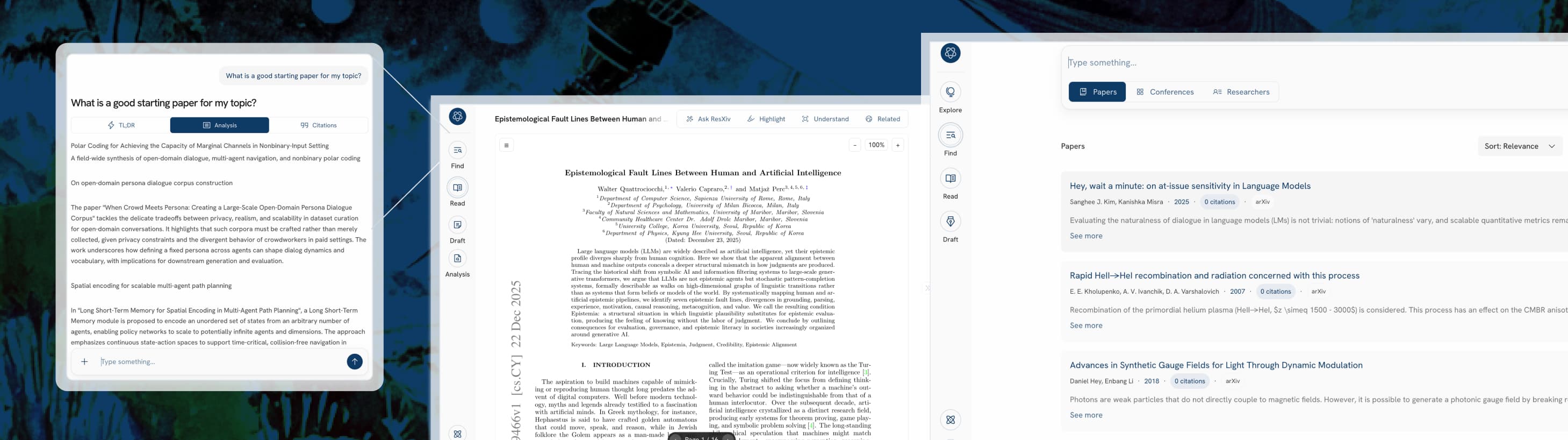
Connected paper discovery, reading, and drafting in one AI-native research workspace.
www.resxiv.comBrief
Coming from an academic research background, I understood:
Academic research is a complex and iterative journey of digesting papers, continuously documenting insights, and collaboratively refining narratives.
The research community struggled with finding, understanding, and linking ever-increasing relevant works, slowing progress and hindering contributions.
Problem space
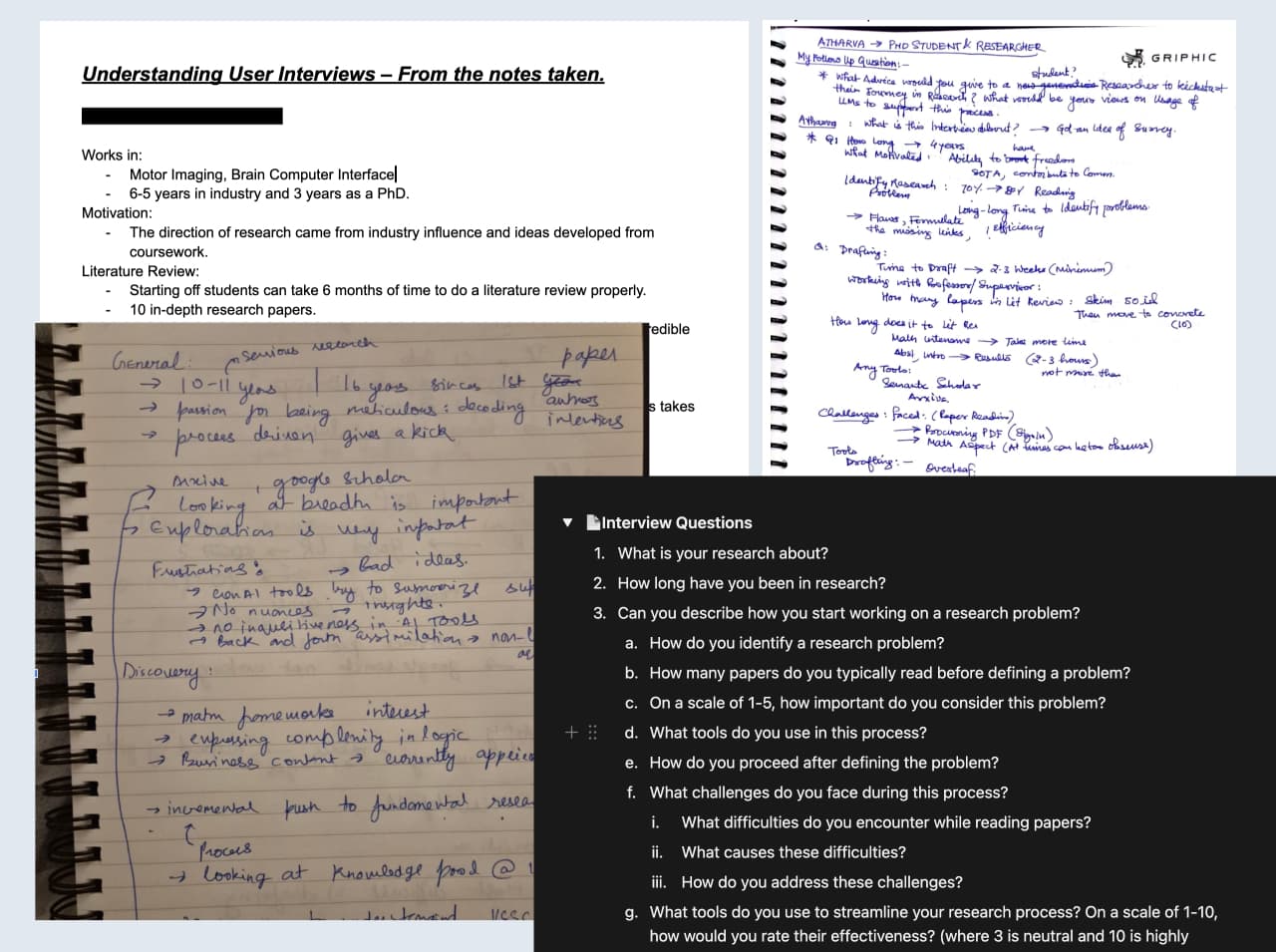
Before building a prototype, I studied existing tools, conducted semi-structured interviews and surveys to deeply understand the research workflows.
Since my co-founder and I both came from research backgrounds, I pushed back when he initially wanted to skip user conversations and move straight into development. I advocated for going back to the field to validate our ideas and discover missed opportunities.
To understand the highs and lows of the researchers’ journey of working on a research problem.
Qualitative research
Each interview ended with open-ended reflection questions to discover personal unmet needs.
We spoke to researchers across geographies because the scientific process is largely similar.
Quantitative research
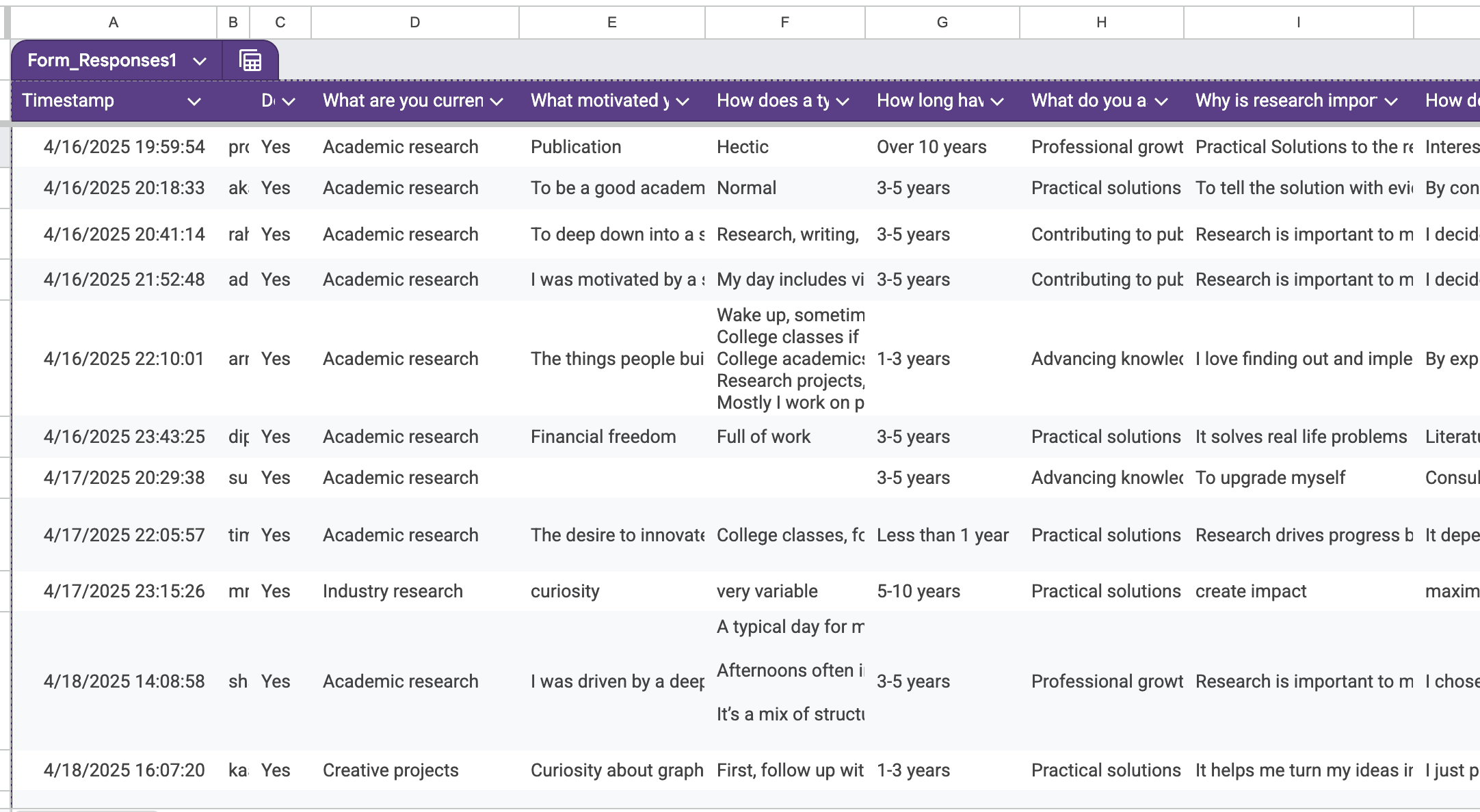
Through a structured survey we captured:
Insights
It dominates early research, often taking months to understand the problem space.
AI can inhibit the intuition researchers build by thinking through a problem.
Researchers struggle to identify meaningful gaps and lose insights across fragmented tools.
Isolated tools force researchers to pay for and stitch together fragmented workflows.
Outdated tools make the final, most deterministic step of narrative building and information compression tedious.
“I spend weeks reading papers, but by the end, I lose track of how they connect. There's just too much to process and I struggle to see the bigger picture.”
“The hardest part is giving structure to research. Tools help me write, not think. What I need is a system that connects the dots for me.”
Existing tools
 SciSpace
 Paperpal
 Anara
Anara AnswerThis
 Overleaf
 NotebookLM
After understanding the market and conducting research, we found the biggest opportunity in:
Connecting fragmented research tools while preserving context and traceability, helping researchers build intuition and move beyond closed, tool-specific workflows.
How might we
Feature prioritization
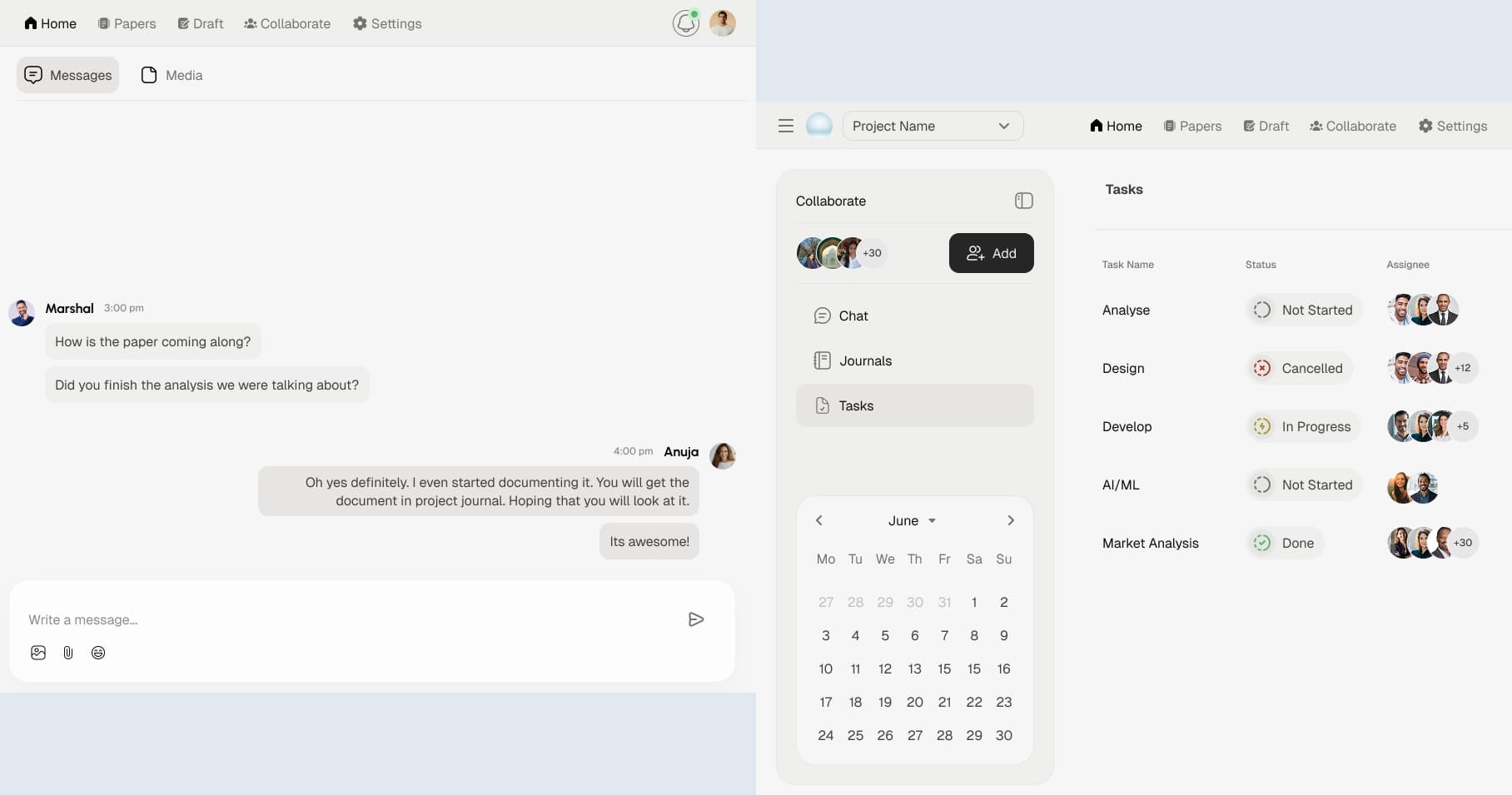
The hardest design challenge was prioritising the features. Initially, we tried solving everything because everything felt important. Our first prototype included themes from: team collaboration, journaling, task management, etc.
Information architecture
I focused on the most time-consuming tasks and where AI could drastically reduce manual work, prioritising workflow efficiency over collaboration efficiency.
Two themes emerged: reading and writing. Therefore, we built an end-to-end stack to support literature review and drafting.
User flow
I started by brainstorming how the selected features would interact with one another to create an intuitive, cohesive experience without adding cognitive overload.
.jpg&w=3840&q=75)
Design 1
Problem
Researchers had to move their notes and paper context into a separate LaTeX editor before they could turn insights into a draft.
Design decision
We designed an AI-native LaTeX editor that turned research documentation into a template-specific research paper in one click and embedded an AI chat for further editing.
Design 2
Problem
The landing page centered on AI chat, while interviews and early usage showed that researchers began with literature discovery.
Design decision
We merged AI search with traditional paper search into one goal-driven search experience centered on the research objective.
Design 3
Problem
Researchers repeatedly mentioned missing citations before conference deadlines, a pain point absent from our original roadmap.
Design decision
We designed the Preprint Analyzer to review manuscripts and identify opportunities for improvement across various aspects.
Design 4
Problem
Researchers moved between disconnected search tools and manually compared results, losing context along the way.
Design decision
We combined AI-guided discovery with traditional paper search around a single research objective.
Design 5
Problem
Reading long papers required constant scrolling and manual extraction of relevant details.
Design decision
We placed a source-grounded AI chat beside the PDF for asking questions, deep-diving into each line, getting an overview and summary, and taking notes.
Design system
ResXiv included many novel interfaces, so I created and maintained a design system from scratch.
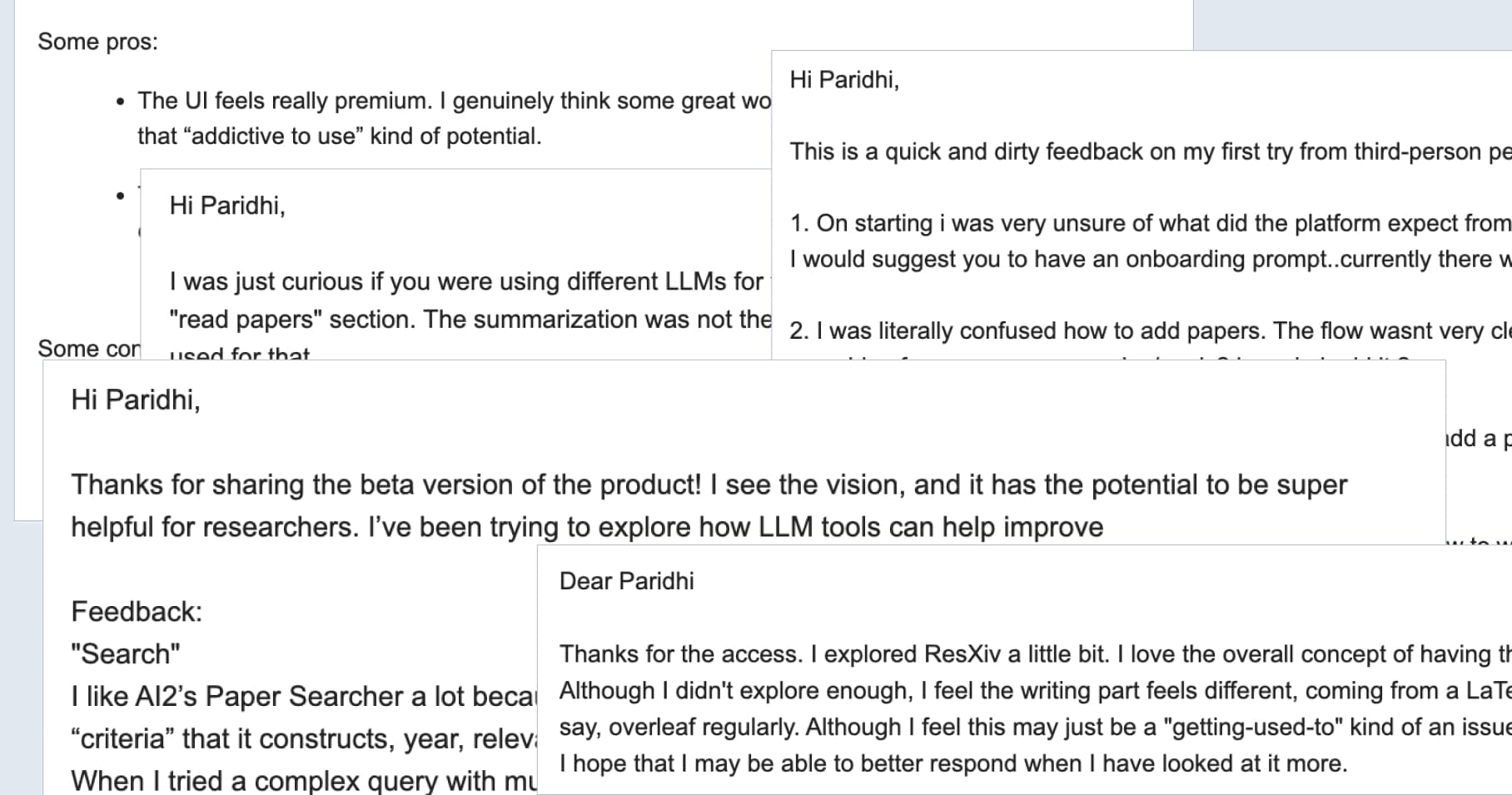
Feedback funnel
Design video
Success & pricing
Since research is reading-heavy, charging only for writing felt misaligned with the value proposition.
We split pricing into Reading and Reading + Writing, keeping core functionality free and charging for AI-powered features. This made researchers feel they were paying only for the value they needed, rather than buying an entire workspace.
Success metrics were also defined separately for reading and writing workflows. Literature review emerged as the most-used feature.
I didn't get the opportunity to fully define success metrics, but they would have been highly feature-dependent.
Impact
ResXiv grew to 300+ MAU and 2,000+ users across 30+ countries in three months of launch including organic signups from researchers from Harvard, Yale, Princeton, CMU, Meta, Microsoft, Adobe, and more.
Retrospective
Learnings
In startups, where things change every day, documentation makes it easier to revisit decisions.
Design decisions landed when tied directly to user-study insights.
Being both the designer and engineer eliminated handoff loops, but prioritising between the two roles became essential.